Hiring good engineers has never been easy, but 2026 made one thing clear: the hardest roles to fill are no longer generic developer jobs. ManpowerGroup's 2026 Talent Shortage Survey found that 72% of employers struggle to fill roles, and for the first time, AI skills topped the list of capabilities employers can't find.
Meanwhile, product teams still ship in two-week sprints. A full-time hire that takes two to three months to land can cost you four or five sprints of work before that person writes a line of code.
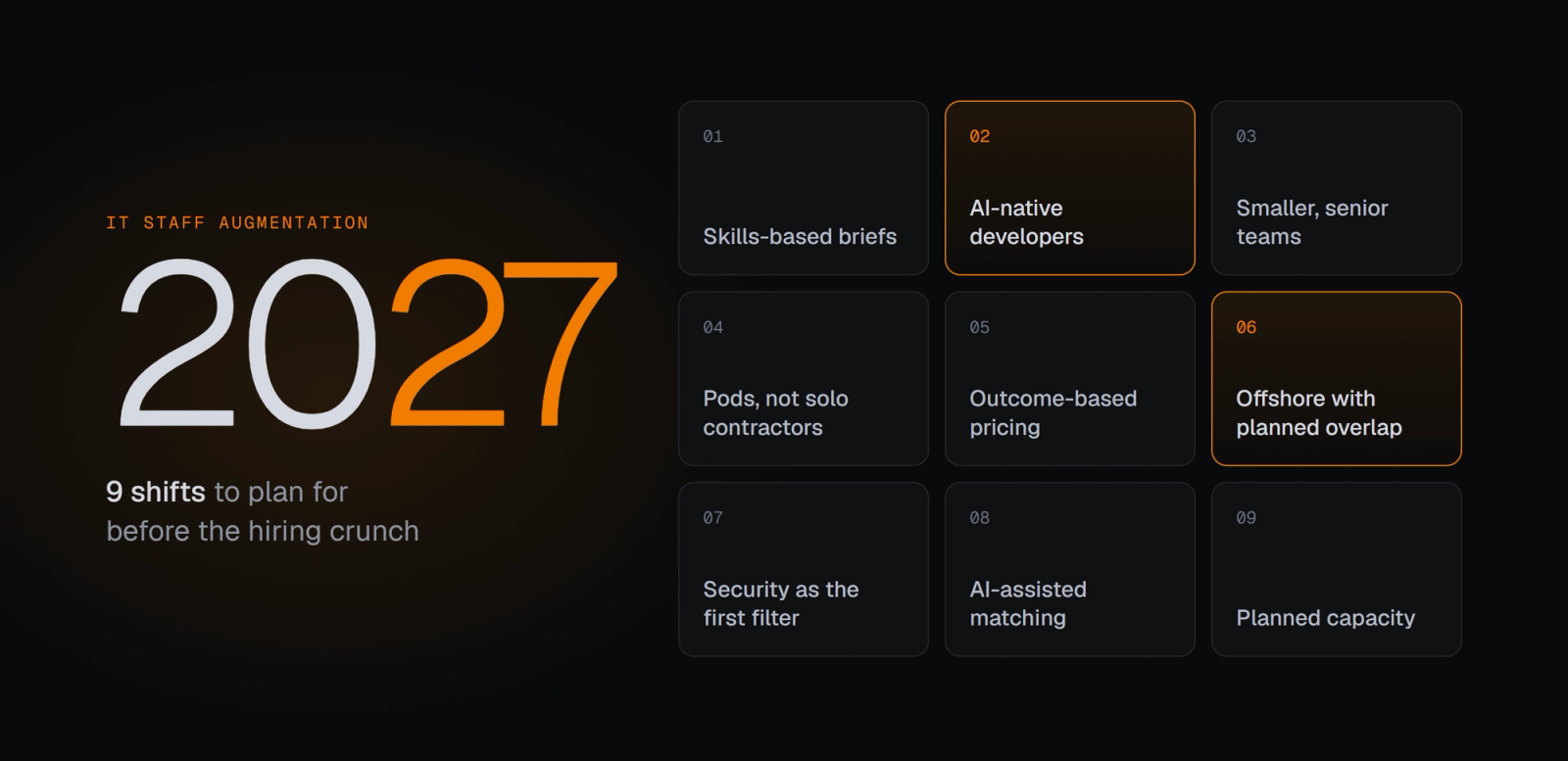
That gap is why IT staff augmentation trends deserve a place in your 2027 planning. Staff augmentation used to be the thing you did after a senior developer resigned. Today, growing companies treat it as part of their roadmap planning. Below are nine shifts we expect to shape how teams extend their engineering capacity next year, and what each one means for you.
Key takeaways
IT staff augmentation means bringing external engineers into your existing team for a set period. They work in your repositories, join your standups, follow your code review rules, and report to your tech lead. You keep control of priorities and architecture. The partner handles sourcing, contracts, payroll, and replacements.
It sits between two other common models:
| Staff augmentation | Dedicated team | Project outsourcing | |
|---|---|---|---|
| Who directs the daily work | Your tech lead | Shared: your product owner, partner's team lead | The vendor |
| Who owns delivery | You | Mostly you, with partner support | The vendor |
| Best for | Filling a specific skill or capacity gap | A long-running product or workstream | A well-defined project you want handed off |
| Typical length | A few weeks to a year | 6 months or more | Fixed scope |
If you're weighing these options, our guides to IT staff augmentation services and dedicated development teams go deeper.
In ManpowerGroup's 2026 survey of more than 39,000 employers, AI model and application development (20%) and AI literacy (19%) were the hardest skills to find, ahead of traditional IT and engineering. Most companies don't need a full AI department. They need one or two people who have already shipped an AI feature to production, and they need them this quarter.
Sourcing, interviewing, negotiating, and onboarding a full-time engineer typically takes two to three months. Release dates, migrations, and funding milestones don't wait that long. When a roadmap depends on a skill nobody on the team has, every week of hiring is a week the roadmap slips.
The global staff augmentation services market is projected to grow from $7.35 billion in 2025 to $11.94 billion by 2032. That growth comes less from companies cutting costs and more from companies wanting flexible access to skills they can't build fast enough in-house.
A title like "senior backend developer" tells a partner almost nothing. Two companies can post the same title and need completely different people. In 2027, the strongest briefs describe the work, not the role.
Old brief: Senior backend developer, 5+ years, Node.js.
New brief: Node.js engineer to build Stripe subscription billing and webhooks before our March release; must have shipped payments in production; works in our GitHub and Jira, 3 hours of overlap with US Eastern time.
What to do: List the deliverable, the stack, the deadline, and the one thing the person must have done before. You'll get fewer profiles, and better ones.
84% of developers already use or plan to use AI coding tools, so "uses Copilot" no longer sets anyone apart. The skill that matters now is judgment: knowing when AI-generated code is wrong, insecure, or quietly slow, and catching it before it reaches production.
For augmented engineers, this matters twice over. They often work on unfamiliar codebases, where AI tools can produce code that looks right but ignores your conventions.
What to do: In interviews, hand candidates a piece of AI-written code with a subtle bug and ask them to review it. How they reason tells you more than any certificate.
82% of business leaders expect AI agents to expand their workforce capacity within 12 to 18 months. In practice, that means routine work such as boilerplate, test scaffolding, and first-pass documentation takes less human time. A feature that needed six engineers may now need four.
The catch: those four need to be stronger. They supervise AI output, make architecture calls, and own quality.
What to do: Budget for fewer, more senior augmented engineers rather than more junior seats.
One contractor holding all the context on a critical module is a risk. If they leave, the project loses weeks. More teams are choosing small pods instead: for example, two developers, one QA engineer and a part-time lead from the same partner, working as a unit inside your sprint. Pods spread knowledge across people, keep handovers clean, and give you one point of accountability.
What to do: For any engagement longer than three months, ask your partner whether a pod model fits better than individual hires. See how a dedicated development team works.
Paying by the hour is simple, but it doesn't tell you whether the work is moving. More engagements now tie part of the fee to milestones: a migration phase completed, a release shipped, test coverage reached.
Outcome pricing isn't always better. If your priorities change every sprint, a rigid milestone contract creates friction. Time and materials with clear KPIs is often the more honest choice for evolving products.
What to do: Use outcome-based terms for well-scoped phases and time and materials for exploratory product work. Agree on how progress is measured either way.
Most trend reports say nearshore beats offshore because time zones matter. Time zones do matter. But the conclusion skips something: the world's largest companies are betting more on India for core engineering, not less.
India hosted 2,117 Global Capability Centers in FY26, generating $98.4 billion in revenue and employing 2.36 million professionals, according to Nasscom and Zinnov. Another 183 GCC units opened in the first half of 2026 alone. These centers run product engineering, AI, and R&D, not just support work.
What makes offshore work is not geography. It's process:
What to do: Don't choose between nearshore and offshore on time zones alone. Ask any partner exactly how many overlap hours they commit to and how they run async handovers.
Need engineers who work in sync with your day? Talk to Techiebutler about planned-overlap teams in India.
Augmented engineers often get access to production systems, customer data, and your core IP. That makes security a selection criterion, not a contract footnote. Expect buyers to ask for ISO 27001 or SOC 2 evidence, GDPR-ready data processing terms and, for AI features sold into Europe, an understanding of the EU AI Act.
What to do: Before day one, confirm IP assignment in the contract, signed NDAs for every engineer, role-based access, time-limited credentials, and an offboarding checklist that revokes everything on the last day.
Partners increasingly use AI to search their talent pools by project history, stack, and domain, not just keywords on a CV. A well-defined brief can produce a relevant shortlist in days rather than weeks.
AI narrows the list; people still make the call. Interviews, a short paid trial task, or a pairing session remain the best test of fit.
What to do: Combine a sharp brief (trend 1) with a partner who can show you named engineers, not anonymous profiles.
Augmentation that starts after a deadline has already slipped rarely goes well. The engineer joins a stressed team, onboarding is rushed, and nobody has time to explain the context.
Teams that get the most from augmentation plan it like any other resource. They look at the roadmap a quarter or two ahead (a cloud migration in Q2, an AI feature in Q3) and line up the skills before the crunch.
What to do: At each quarterly planning session, ask one question: which upcoming work needs a skill we don't have in-house?
None of these models is better in general. Each fits a different kind of gap.
| Staff augmentation | Full-time hire | Project outsourcing | |
|---|---|---|---|
| Time to start | Usually 1 to 3 weeks | Usually 2 to 3 months | 2 to 6 weeks, after scoping |
| Cost model | Monthly or hourly, flexible | Salary plus benefits, recruiting and equipment | Fixed price or milestones |
| Control | You direct the work | You direct the work | Vendor directs the work |
| Best for | Skill gaps, release crunches, migrations | Long-term ownership and leadership roles | Self-contained projects |
| Main risk | Weak onboarding or unclear ownership | Paying for a role after the need passes | Less day-to-day visibility |
Many teams use all three: full-time hires for product leadership, augmented engineers for specialist and peak work, and outsourcing for well-defined side projects.
Rates vary widely with location, seniority, and stack. A senior AI or cloud engineer costs more than a mid-level web developer anywhere in the world, and onshore rates in the US and Western Europe are typically several times those in India.
But the hourly rate is the wrong number to compare. Look at the total cost of getting work accepted:
A cheaper engineer who needs constant supervision often costs more than a stronger one who ships cleanly. Compare partners on cost per accepted deliverable, not cost per hour.
Staff augmentation is not the answer to every problem. Choose a different model if:
Techiebutler is a custom software development company based in India. We help startups and growing businesses extend their engineering teams with vetted developers who join your workflow, your tools, and your sprint rhythm.
Ready to close your skills gap? Book a free consultation with Techiebutler.
The common thread across these trends is a shift from filling seats to planning skills. Companies that get the most from staff augmentation in 2027 will know exactly which skills their roadmap needs, bring them in before the crunch, and treat external engineers as part of the team from day one.
If your roadmap needs skills your team doesn't have yet, talk to Techiebutler. We'll help you figure out the right model and the right engineers for the work ahead.


