Cybersecurity staff augmentation means bringing external security experts onto your existing team for a defined stretch of time. Your team sets the priorities, and the specialists fill the skill gaps. With long hiring cycles and compliance dates moving closer in 2026, more engineering leaders are choosing this route.
Here's a scenario many CTOs will recognize. The SOC 2 auditors arrive in three months. Your AWS footprint grew twice as large over the past year, and no one has done a proper review of it. The single security engineer on staff spends the day juggling alert queues, permission tickets, and developers asking for a fast sign-off on their pull requests.
You open a requisition for a senior cloud security role. Four weeks pass, and the pipeline still hasn't produced a strong candidate.
You're far from alone. According to ISACA's most recent State of Cybersecurity research, close to two thirds of organizations (65%) report open security positions. Threat actors don't wait for your recruiting team to catch up.
Staff augmentation closes that gap. In this guide, we cover what the model is, how an engagement runs, which roles companies bring in most often, how it compares with an MSSP and direct hiring, and how to pick a partner you can trust.
In simple terms, cybersecurity staff augmentation is a way to add security expertise without adding headcount. A staffing partner recruits, employs, and pays the specialist. You direct the day-to-day work: the priorities, the toolset, and the reporting line. Once the engagement wraps up, the specialist leaves, and everything they built remains inside your environment.
Think of a hospital bringing in a locum surgeon. The visiting doctor follows the hospital's protocols, works alongside its staff, and answers to its chief of medicine. The hospital hasn't handed off patient care. It has simply covered a specialty it was missing.
In one line: specific expertise, for a defined period, with you in charge.
That last part is what separates augmentation from outsourcing. When you outsource, a vendor takes ownership of the outcome. When you augment, ownership stays with your team, and you simply gain extra expert capacity. If you're new to the model, our guide to what IT staff augmentation is covers the basics.
The model has been around for years. The difference in 2026 is that security leaders are facing three separate pressures at once.
For a long time, the headline figure was the size of the global cybersecurity workforce gap. ISC2 estimated it at 4.8 million in its 2024 report. In its 2025 study, ISC2 stopped publishing that number altogether, because survey participants consistently pointed to missing capabilities, rather than missing staff, as their main problem.
The same research found that 95% of organizations are dealing with at least one skills shortfall. AI security (41%) and cloud security (36%) lead the list.
For a hiring manager, the takeaway is clear. You probably don't need a whole new department. You might need one engineer who can lock down your cloud workloads, or one specialist who can test an LLM feature before release. Those people exist. Getting them onto your payroll quickly is where things break down.
ISACA's data shows how slow the process has become. Around 38% of organizations say junior security roles take three to six months to fill, and 39% report the same timeline for senior positions. Roughly half also say retaining security staff is a challenge.
A three to six month search works when there's no deadline. It fails when an audit date, an enterprise client's vendor risk assessment, or a product launch is already fixed.
2026 is packed with regulatory milestones. In the US, CMMC Level 2 certification requirements apply to defense contractors handling controlled unclassified information from November 10, 2026. In the EU, organizations are working through NIS2 and DORA obligations, and the Cyber Resilience Act's vulnerability reporting duties started in September.
Every new regulation creates short-term demand for specific expertise, such as GRC consultants, security awareness trainers, and OT security engineers. Many companies need these people intensely for a few months and much less afterwards. That pattern is exactly where augmentation makes sense.
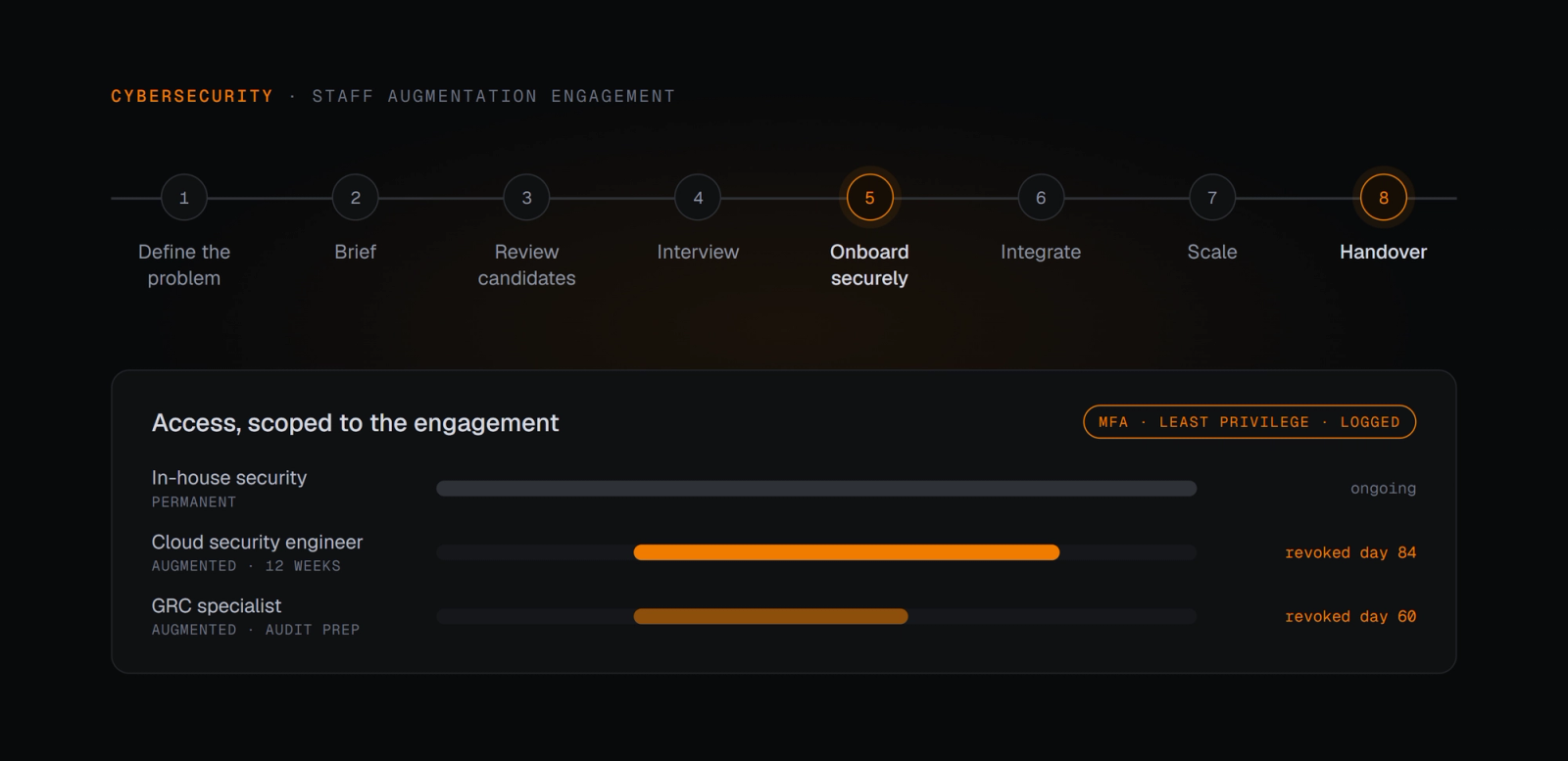
Teams often expect the setup to drag on. In practice, a reliable partner can usually have a screened specialist working with you in a matter of weeks. Here is what a standard engagement looks like.
Step 8 gets skipped more than any other, and it decides whether you keep the expertise or only rented it for a while.
Almost any security function can be filled this way. These are the roles companies request most often.
| Role | Responsibilities | Typical trigger |
|---|---|---|
| SOC analyst | Watches alerts, digs into suspicious events, prioritizes incidents | Your team can't keep up with alert volume |
| Penetration tester | Runs authorized attacks to uncover exploitable weaknesses | Ahead of a product launch, fundraise, or large enterprise contract |
| Incident responder | Contains threats and leads recovery after a breach | While an incident is active or immediately after |
| Cloud security engineer | Hardens AWS, Azure, or GCP environments, identity and access, and containers | During a cloud migration or rapid scaling |
| AppSec / DevSecOps engineer | Embeds security testing into code reviews and CI/CD pipelines | Frequent releases with vulnerabilities caught too late |
| GRC and compliance specialist | Maps controls, gathers evidence, and gets you audit-ready | SOC 2, ISO 27001, HIPAA, NIS2, or CMMC timelines |
| Security architect | Designs secure systems and reviews major technical choices | A new platform, a large redesign, or an AI rollout |
| Fractional CISO (vCISO) | Sets security strategy and mentors the team part time | You need executive-level direction without full-time CISO costs |
These three options get confused often, so here's a clear breakdown. A direct hire joins your payroll. An MSSP (managed security service provider) delivers a defined service, such as round-the-clock monitoring, using its own people and tooling. Staff augmentation places experts inside your team to work under your processes.
| Factor | In-house hire | MSSP | Staff augmentation |
|---|---|---|---|
| Who directs the work | Your team | The provider | Your team |
| Ramp-up time | 3 to 6+ months | A few weeks | Typically a few weeks |
| How you pay | Salary, benefits, training, retention costs | Fixed monthly fee | Only for the people and hours you use |
| Flexibility | Low | Moderate, depends on contract terms | High, scale in either direction |
| Who keeps the knowledge | You | Largely the provider | You, provided it's documented |
| Ideal use | Core, permanent security functions | 24/7 monitoring and standardized services | Projects, skill gaps, deadlines, workload spikes |
None of these is the right answer in every case. A sensible split is to use an MSSP for continuous SOC monitoring and use augmentation for audit preparation, clearing remediation backlogs, and fractional leadership.
Many organizations combine all three: a lean internal security team, an MSSP covering overnight monitoring, and augmented specialists for projects and peak periods.
It's a strong option, but not a universal fix. Here's an honest view.
It's a good fit if:
Reconsider if:
Feeling cautious about giving external people visibility into your security setup is reasonable. That caution is a healthy sign. The good news is that every typical concern has a straightforward fix.
| Concern | Mitigation |
|---|---|
| External people accessing sensitive systems | Apply least-privilege access, enforce MFA, and log all activity. Grant only what the role requires and review permissions on a schedule. |
| Uncertainty about skill level | Request relevant certifications such as OSCP, CISSP, CEH, CISM, or cloud security credentials. Conduct your own technical interviews and verify references. |
| Losing knowledge when the engagement ends | Make documentation a requirement from the first week. Store playbooks, runbooks, and configurations in your systems, not on personal devices. |
| Working across time zones | Set a fixed daily overlap, commonly three to four hours, along with regular standups and shared communication channels. |
| Data protection and legal exposure | Include NDAs, IP ownership terms, and data handling requirements in the contract before granting any access. |
| Access that remains after offboarding | Follow a written offboarding checklist and disable every account, key, and token on the final day. |
There's no single price, because you pay for specific specialists over a specific period. These factors shape the rate:
The specialists matter, but so does the company supplying them. Ask these questions before you sign:
Security gaps rarely wait for a hiring cycle to finish. Cybersecurity staff augmentation lets you bring in the exact expertise you need, on your timeline, while keeping ownership of the work and the knowledge it produces. Start with a clearly defined problem, choose a partner with rigorous security vetting, and treat documentation and offboarding as non-negotiable.
If you're looking to add vetted engineers to your team, Techiebutler can help you scale quickly with offshore specialists who work inside your processes and tools. See how our staff augmentation services work, or talk to our team.


