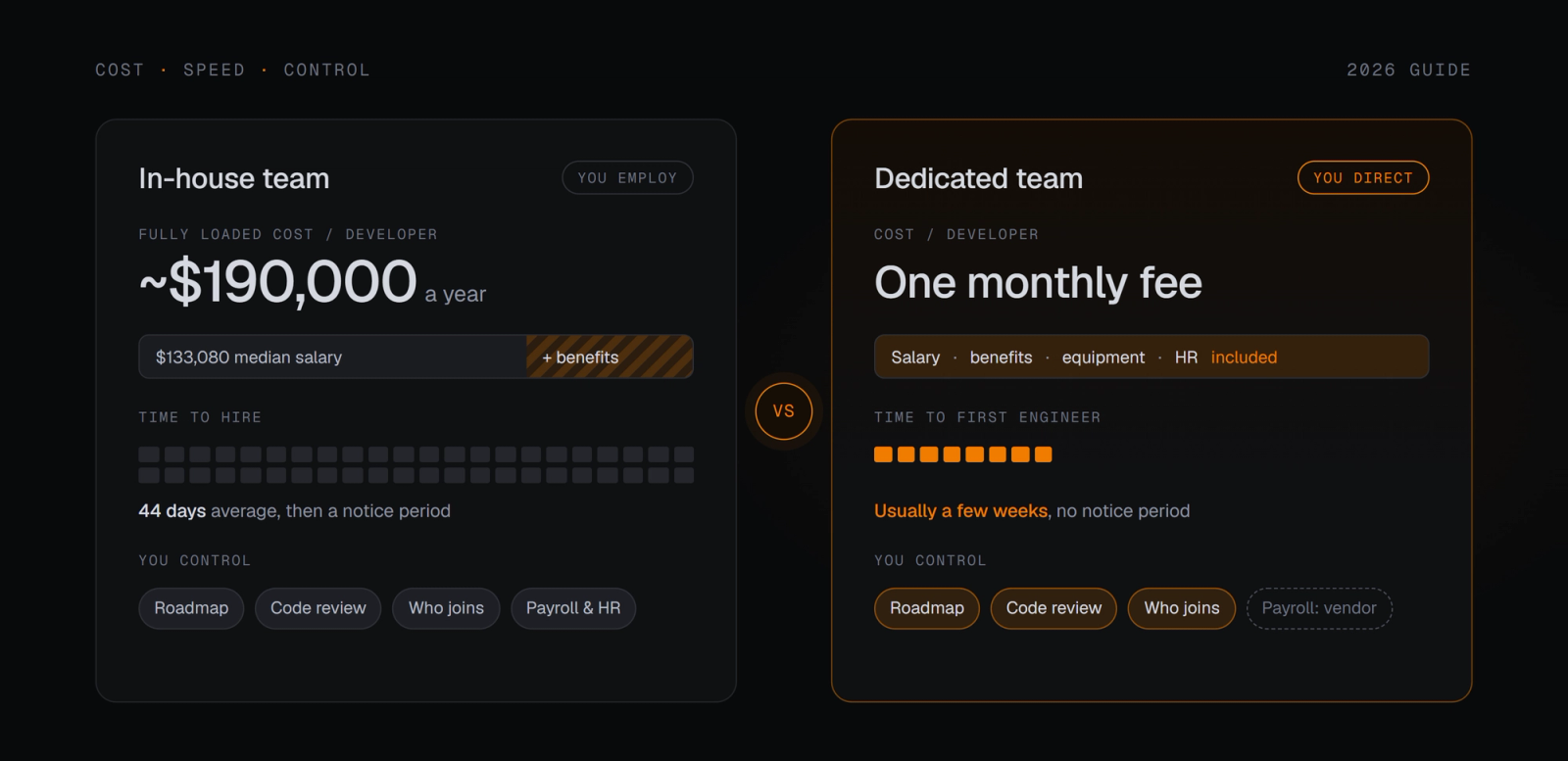
Build an in-house team when the software is the business; the roadmap runs for years, and you can wait months to fill up seats. Hire a dedicated development team when you need engineers shipping in weeks, when US salaries plus benefits would eat the budget, or when you can't predict headcount a year out. Plenty of companies end up running both.
That's the short version. The rest of this post breaks down what founders and CTOs actually argue about when they make this call: what each model costs once you count everything, how fast each one gets code into production, and how much say you keep over the work.
| In-house team | Dedicated development team | |
|---|---|---|
| Who employs the engineers | You | The vendor |
| Who directs the daily work | You | You |
| Cost structure | Salary, benefits, recruiting, equipment, office | One monthly fee per engineer |
| Time to first engineer | Weeks to months of hiring, plus notice period | Usually a few weeks |
| Scaling down | Layoffs, severance, morale hit | Contract notice period |
| Hiring and replacement | Your recruiters and HR | The vendor's job |
| Best fit | Core product, long horizon, stable headcount | New builds, fast ramp, changing headcount |
A dedicated development team is a group of engineers employed by an outside company who work full-time on your product and nothing else. They join your stand-ups, commit to your repositories, and pick up tickets from your backlog. You decide what gets built. The vendor handles hiring, payroll, benefits, hardware, office space, and replacing anyone who leaves.
People often mix it up with other outsourcing models, so here's how they differ:
An in-house team is a familiar one. You post the job, interview, make the offer, put people on payroll, and they're yours.
Start with salary, because that's where most comparisons start and stop.
The US Bureau of Labor Statistics puts the median annual wage for software developers at $133,080 (May 2024). That's the number of people dropping into the spreadsheet. It's also the wrong number.
Salary is only part of what an employer pays for. BLS employer cost data for December 2025 shows wages and salaries make up about 70% of total compensation for private industry workers. The other 30% is benefits: health insurance, paid leave, retirement contributions, and legally required payroll costs.
Run the math on that median developer:
And that still leaves out:
The 70/30 split is an all-industry average, too. Tech companies often add equity and richer perks, so treat $190,000 as a floor. For a team of five engineers at the US median, you're looking close to $1 million a year before you've paid a recruiter or bought a single laptop.
A dedicated team is usually billed as one monthly rate per engineer. That rate covers the engineer's salary, benefits, equipment, workspace, and the vendor's HR and replacement overhead. Rates depend on seniority, tech stack, and location, and offshore teams in India typically cost a fraction of the US loaded figure above.
Here's the mistake we see most often: comparing a vendor's monthly rate against an in-house base salary. That makes the dedicated team look pricier than it is. Compare the vendor's annual cost (monthly rate × 12) against the fully loaded in-house number. That's an honest comparison.
But be honest about the dedicated side too. You'll still pay for:
For startups and mid-sized companies, the dedicated model usually comes out well ahead on cost. It stops making financial sense when you have a large, stable team for many years, and your own recruiting engine already runs smoothly.
Picture this. You get budget approval for three new backend engineers on January 6. You write job descriptions, post the roles, and start screening.
Gem's 2025 Recruiting Benchmarks Report found average time-to-hire rose from 33 days in 2021 to 41 days in 2024. SHRM's 2025 benchmarking puts the US average across all positions at 44 days. Senior and specialist engineering roles take longer.
So, your first offer gets accepted around mid-February, if things go well. The candidate gives two weeks' notice at their current job. They start in early March and spend their first few weeks reading code, setting up environments, and shipping small fixes. Their first meaningful feature lands somewhere in April.
That's one engineer. You needed three.
And they rarely land in the same month. One candidate takes a counteroffer. Another fails in the final round. You restart the search, and the feature that got the budget approved still doesn't have a single commit.
A dedicated team vendor already employs engineers and keeps a pipeline of candidates warm. Your job is to describe the roles, interview a shortlist, and approve the people you want. There's no notice period to wait out, because they already work for the vendor. Getting a team started in weeks instead of a quarter is normal.
The speed advantage doesn't stop at day one. Need two more engineers for a launch? The vendor adds them. Need to shrink after the launch? You give notice under the contract instead of running a layoff.
Where in-house wins on speed is after the first year. An engineer who's been on your product for three years knows why that strange billing edge case exists. That context is hard to replace, which is why a vendor's turnover and replacement policy matters so much.
"I'll lose control" is the objection we hear most, and it usually comes from confusing dedicated teams with project outsourcing.
With a dedicated team, you control:
What you give up is the employment relationship. You don't set their salary, you don't run their performance reviews, and you can't stop them from resigning. The vendor does those things. You also lose some of the informal glue of a shared office, like overhearing a conversation or pulling someone into a whiteboard session.
In-house teams do win on control in a few situations:
For everything else, control comes down to the contract and your setup. Make sure:
Go in-house when most of these are true:
Go with a dedicated team when most of these are true:
In practice, this is rarely either/or.
The setup we see most: a small in-house core (a CTO or tech lead, a product owner, maybe a senior engineer or two) who own the architecture and the roadmap. Around them sits a dedicated team that does most of the building. The in-house people hold the long-term context. The dedicated team gives you the capacity you can turn up or down.
It can grow fast, too. One of our client engagements started with a single embedded engineer and scaled to more than 50, while the client kept product and architecture decisions in-house the whole way. You can read more in our case studies.
If a vendor is vague on any of these, keep looking.
Techiebutler is an offshore software development company based in Rajkot, India. We build dedicated engineering teams that join your stand-ups, work in your codebase, and follow your standards, across US and UK time zones. Start with one developer or a full team and scale as your roadmap changes.
Want to see what your team would cost compared with hiring in-house? Book a 30-minute discovery call.
Usually, yes, once you compare fully loaded costs. A US in-house developer at the BLS median salary costs roughly $190,000 a year with benefits, before recruiting and equipment. A dedicated team's monthly rate covers salary, benefits, equipment and HR, and offshore teams typically cost a fraction of that.


