A couple of years back, hardly anyone had heard the term "LLM engineer". Now it's in job ads everywhere, and nobody seems to agree on what it means. One company wants a person who writes good prompts. The next wants someone who can fine-tune a 70-billion-parameter model on their own GPU cluster.
So, before you hire LLM engineers, the first job is figuring out which of those people you're after.
Think of them as somewhere between a backend engineer and a machine learning engineer. Their whole focus is on building systems around large language models and making those systems reliable, accurate, and not ridiculously expensive.
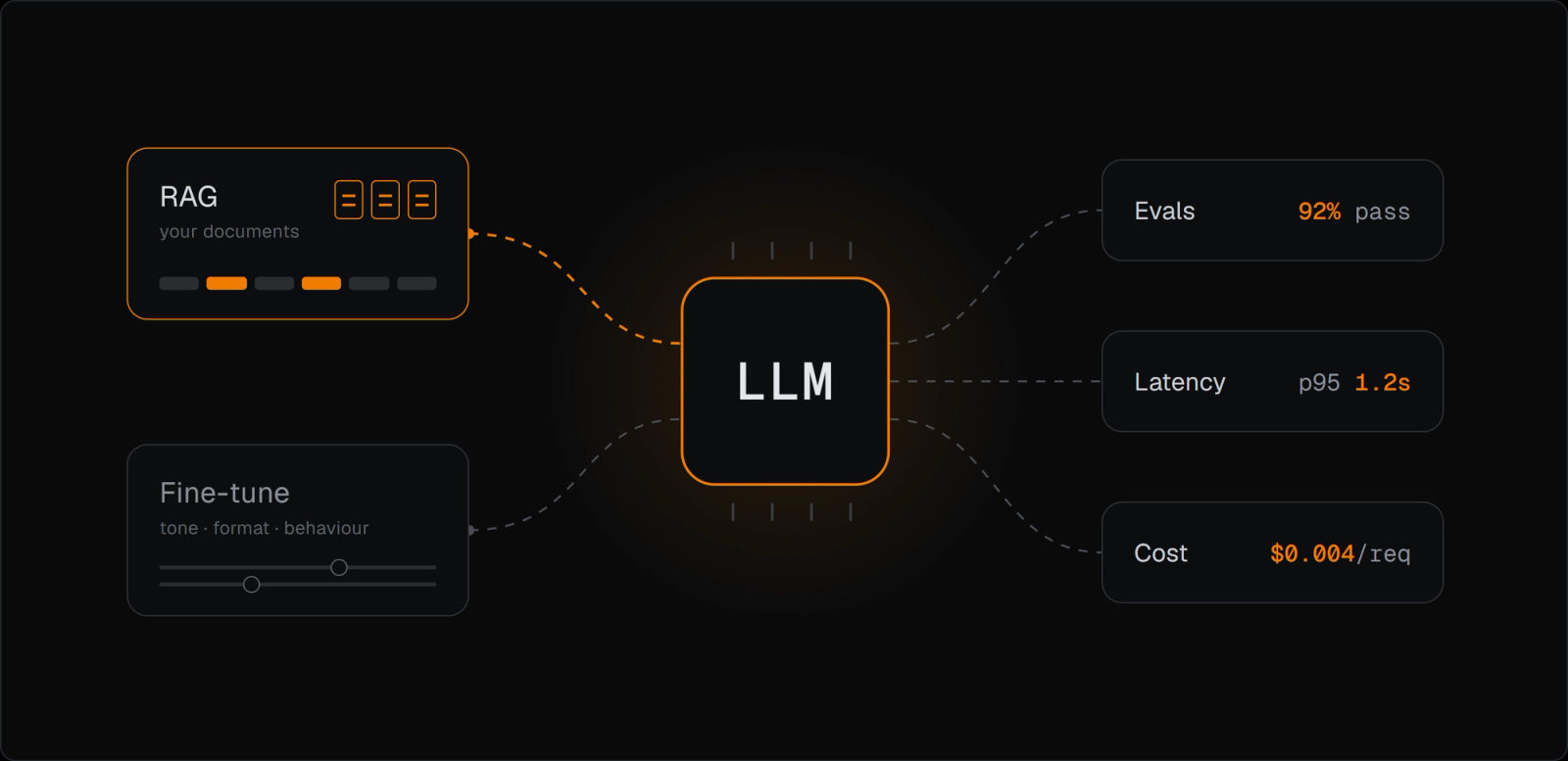
In practice, that means picking up the right model, hooking it up to your company's data, designing prompts and agent workflows, checking the quality of what comes out, and keeping it all running in production. On some projects, they'll also fine-tune models or host open-source ones on your own servers.
Honestly, not every company does. You probably need a dedicated LLM engineer if language models are a core part of your product rather than a nice extra. Same if you handle sensitive data and might need to host models privately, or if your AI features work fine in testing but fall apart (or cost a fortune) in production. Planning agents that take real actions, like updating customer records or sending messages? That's another strong sign.
On the other hand, if all you want is a "summarise this" button in your app, a good full-stack developer with some LLM experience might be all you need. Be honest about the size of the problem before you open the role.
The strongest LLM engineers we've worked with tend to be good at five things.
They know the models. They understand how different models compare in quality, speed, context length, and price, and they can tell you when an open-source model like Llama or Mistral beats a hosted API.
They're good at getting the right context to the model. Most business use cases live or die on this. Embeddings, vector search, hybrid search, reranking, and chunking documents sensibly.
They test properly. This is the skill most often missing, so push on it. A good LLM engineer builds test sets, mixes automated and human review, and tracks quality over time, so a small change doesn't quietly break everything.
They know about production. Streaming responses, caching, rate limits, falling back to another model when one fails, logging, cost tracking. Language models are slow and pricey compared with normal code, so this stuff really matters.
And they take security seriously, especially prompt injections and data leaks. That goes double when the model can call tools or see private records.
If we could only ask a candidate one thing, it might be this: when would you fine-tune a model, and when would you use retrieval augmented generation (RAG)?
There's no single right answer, but a thoughtful one sounds roughly like this. RAG is usually the first move when the model needs up-to-date or company-specific knowledge, because you can update documents without retraining anything. Fine-tuning earns its place when you need a consistent tone, format, or behaviour, or when you want a smaller, cheaper model to get really good at one narrow task. Plenty of solid systems use both.
If someone jumps straight to fine-tuning for everything, they might be adding cost and complexity you don't need. If they've never even thought about it, they could hit a wall on harder projects.
Go for questions that pull out real experience:
After that, a short-paid task. Ask them to build a small retrieval-based tool on some sample data and include a basic evaluation report. Funnily enough, the report usually tells you more than the code.
LLM engineers with real production experience are thin on the ground, and the good ones are usually well looked after where they are. Recruiting one full time can drag on for months.
You have three realistic options. Hire in-house if LLMs are central to your long-term product and you can afford to wait. Bring in a contractor for a short, focused build. Or work with a development partner that already has LLM engineers on the team, so you can start fast and grow the team as the project grows.
Quite a few companies mix these. They use a partner to ship version one, then hire in-house once they've got a much clearer idea of what they need.
Hiring LLM engineers the right way comes down to knowing your use case, testing judgement as much as technical skill and paying close attention to how people measure quality. The best people in this space aren't the ones with the longest tool list. They're the ones who can make a language model behave itself for real users, day after day.
Want to move faster? An experienced AI development company can give you access to vetted LLM engineers without the long search. At Techiebutler, we build dedicated AI teams for startups and growing businesses, covering everything from RAG systems and AI agents to private model deployments. Tell us about your project and we'll help you plan the right team.


