A generative AI demo is easy. Give a decent developer an API key and a free afternoon, and you'll have a chatbot that answers questions about your company. It'll look great in the meeting.
The trouble starts a week later, when a customer asks something slightly unusual, and the bot confidently makes up a refund policy you've never had.
That gap, between "wow, it works" and "we trust this with customers", is what you're really hiring for. This guide is for founders, CTOs and product leads who want to hire generative AI developers who can close it.
Forget the job title for a second. A generative AI developer builds products on top of models that write text, generate code, or create images. For most companies today, that means large language models from OpenAI, Anthropic, Google, or open-source ones like Llama.
Very little of the job is about the model itself. Most of it is the stuff around it:
Training a model from scratch? Almost never needed. If a candidate leads with that, gently ask why.
The biggest mistake we see is a company hiring one GenAI developer and handing them six projects. Nothing ships.
Pick a single use case with an obvious payoff and a human safety net. A few that tend to work well as a first project:
Then write down one number that defines success. "Support team saves 10 hours a week" is good. "Better customer experience" is not. That number becomes the target for whoever you hire, and it gives you something fair to judge them against in month three.
Say you picked the internal assistant. Your shortlist of must-haves is now pretty clear:
If you'd picked contract extraction instead, you'd swap RAG for structured outputs and document parsing. If you want an agent that takes actions, add tool calling and permission design.
Notice what's not on the list: ten years of experience. The field is only a few years old. Look for shipped projects instead.
If you remember one thing from this post, make it this: ask every candidate how they test their outputs. People who build real products have a clear answer. People who build demos usually don't.
The good ones leave a trail. A GitHub repo with a working RAG project. A blog post about why their first retrieval setup failed. A LinkedIn post comparing two embedding models. That kind of thing tells you far more than a certificate.
Referrals are gold here too. So are development partners who've already shipped a few GenAI products, because their people have usually hit (and fixed) the problems you haven't met yet.
Pay for it, keep it to about four hours, and make it look like your actual use case. Here's a brief you can borrow:
"Attached are 20 pages of our product docs. Build a small tool that answers customer questions using only these docs. Then write 10 test questions, run them, and tell us which answers were wrong and why."
The second half is where you learn the most. A strong candidate comes back with something like: "7 out of 10 correct. Two failures were because the answer was split across two pages, so I'd change the chunking. One was a question the docs don't cover, so the bot should say it doesn't know." That's someone you can build a product with.
A weaker candidate sends a nice-looking chat window and nothing else.
Generative AI breaks in odd ways, so that's what the interview should poke at. Some questions we like, with what a good answer usually includes:
"How do you reduce hallucinations?" Look for: better retrieval, telling the model to say "I don't know", showing sources, and testing. Not just "use a better prompt".
"Your provider updates the model and outputs change. What now?" Look for: pinned model versions, a test set they rerun before switching, and a fallback model.
"Usage grows 10x. How do you stop costs exploding?" Look for: caching common answers, smaller models for simple tasks, shorter prompts, usage limits.
"How do you stop prompt injection?" Look for: never trusting user input, limiting what the model can access, and checking outputs before any action is taken.
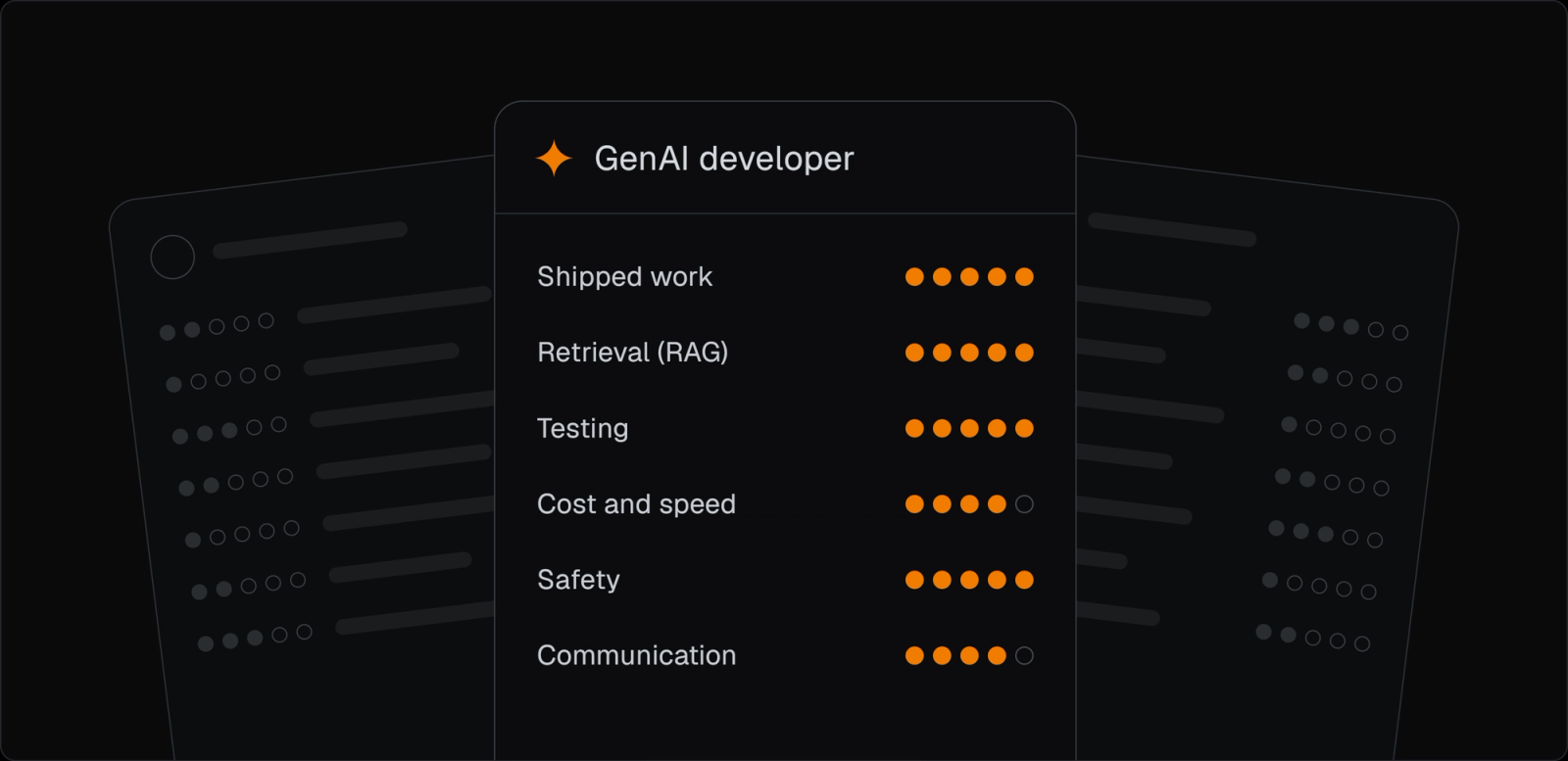
After each interview, score the candidate 1 to 5 on these. It keeps the decision honest when several people are involved.
| What you're checking | What a 5 looks like |
|---|---|
| Shipped work | Has GenAI features live with real users, can talk about what broke |
| Retrieval (RAG) | Can explain chunking, embeddings and how they improved results |
| Testing | Builds test sets without being asked and measures quality in numbers |
| Cost and speed | Knows rough costs of their past systems and how they cut them |
| Safety | Talks about data privacy and prompt injection unprompted |
| Communication | Explains trade-offs clearly to a non-technical person |
Before day one, decide which model providers are allowed, what data can be sent to them, and who signs off on privacy. Then give your new hire real data in week one, not month two.
Launch is small. Ten internal users for two or three weeks, a feedback button on every answer, and a weekly look at what went wrong. Only then open it up to customers.
Hiring generative AI developers well comes down to a few habits. One use case, one success number, a test task that looks like the real job, and an interview that focuses on what goes wrong. Do those four things and you'll avoid most of the expensive mistakes.
If you'd rather skip months of recruiting, a trusted AI development company can put an experienced team on your project much faster. At Techiebutler, we build dedicated teams of generative AI developers for startups and growing businesses, from the first use case right through to launch. Tell us what you're planning, and we'll suggest the right team for it.
No. Prompt writing is one small part of the job. A generative AI developer also builds the retrieval system, the backend, the tests, and the guardrails. Hiring someone who only writes prompts usually leaves you with a fragile demo.


