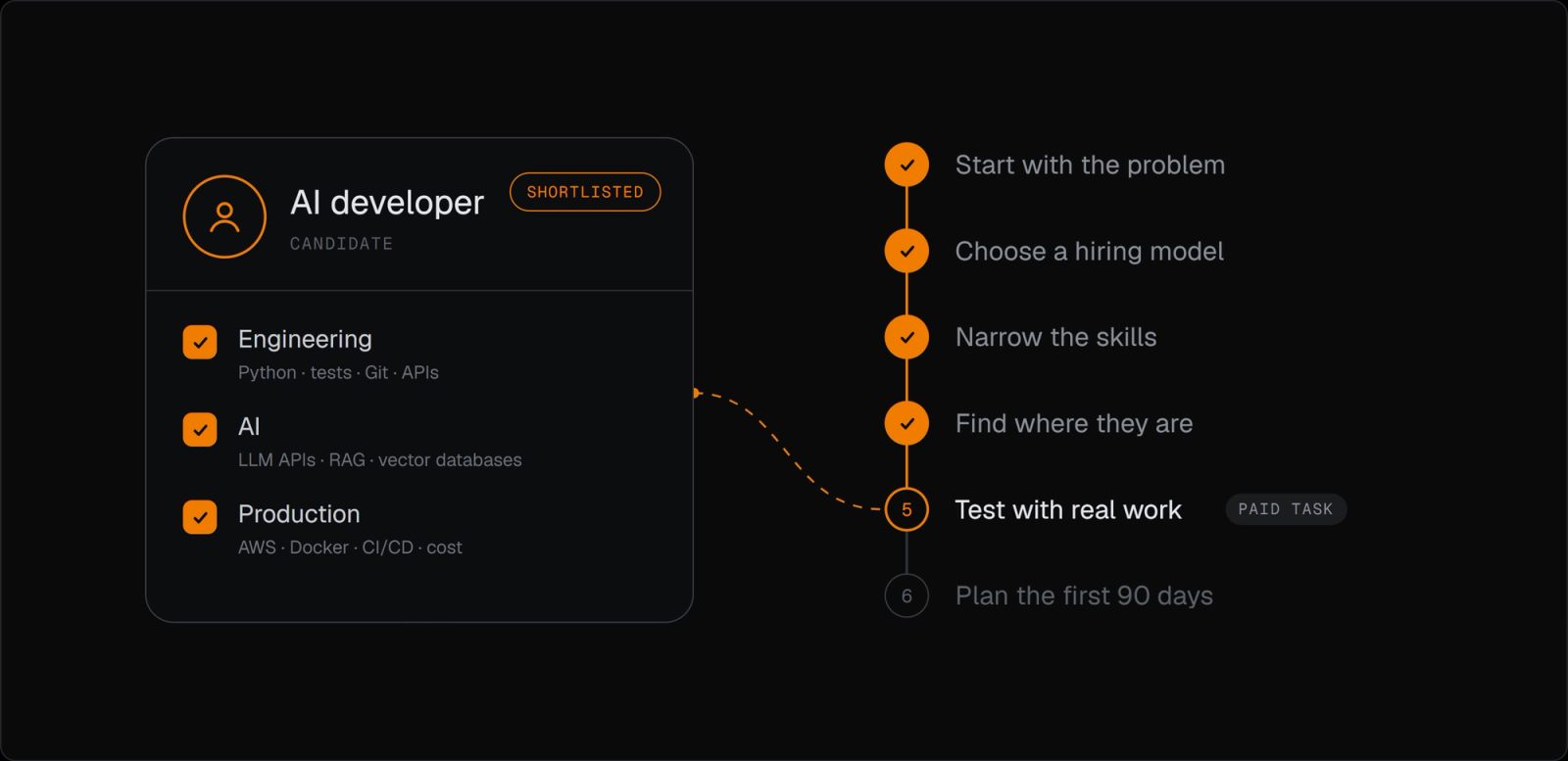
Here's something we hear on almost every first call: "We need AI developers. Can you send us some CVs?"
Fair enough. But when we ask what the developers will actually build, the answer is often a bit fuzzy. A chatbot, maybe. Something with our data. "We'll figure it out once the team is in."
That's usually where things go sideways. "AI developer" can mean someone who plugs ChatGPT into a support desk, or someone who trains a custom model on ten years of sensor readings. Those are very different people. Hire the wrong one, and you'll spend six months finding out.
So, before you post that job ad, here's how we'd approach it.
Grab a notepad and write one short paragraph. What should AI fix? What data do you have? How will you know it's working?
Something like: "Our support team answers the same 200 questions every week. We've got three years of tickets in Zendesk. We'd like a bot that handles about 30% of them on its own."
That one paragraph does a lot of heavy lifting. Now you know you need someone comfortable with language model APIs, retrieval and support workflows. You probably don't need a deep learning researcher.
Now compare it with "we want to predict which machines on the factory floor will break down next month." Completely different skill sets. Time series data, classic machine learning, lots of back-and-forth with the operations team.
Can't write the paragraph yet? That's fine, and honestly pretty common. Run a short discovery phase before committing a full-time hire. A week or two with someone who's built AI systems before will save you a lot of wasted interviews.
There's no single right way to bring AI developers on board. It depends on where you are right now.
Full-time, in-house. Makes sense when AI sits at the heart of your product, and you want someone to own it long term. The catch? It's slow. Senior AI people are hard to find and harder to keep.
Freelancers. Handy for quick proof of concept with a tight scope. Less handy when the thing needs maintaining, securing, and improving for the next two years.
Staff augmentation. You already have a tech lead and a team; you just need more hands with AI experience. Augmented developers slot into your process and report to your people.
A dedicated team. You get developers, project lead, and QA who already know how to work together. Good for companies that want something shipped without building an AI department first.
A pattern we see a lot: companies start with a dedicated team to get version one out the door, then hire in-house once they know the product has legs. You don't have to decide forever. Just decide for this quarter.
Once the problem is clear, the wish list gets a lot shorter. Most good AI developers bring three things to the table.
The first is plain old engineering. Python they can write in their sleep, tests, Git, and APIs. People forget this part. An AI feature is still software, and if nobody can deploy it, monitor it or fix it at 2 a.m., you've got a demo, not a product.
The second is the AI bit, and this is where your problem paragraph pays off. Building on top of large language models? Look for hands-on time with OpenAI or Anthropic APIs, retrieval-augmented generation (RAG), vector databases, and prompt design. Predicting churn or demand? Then it's scikit-learn, PyTorch or TensorFlow, feature engineering, and knowing how to evaluate a model properly.
The third is production experience. AWS, Azure or GCP. Docker. CI/CD. And cost awareness, which is underrated. Anyone who's watched an API bill jump overnight builds things differently from someone who's only ever worked in notebooks.
Our rule of thumb: one deep specialty plus solid fundamentals beats a CV stuffed with every buzzword going.
The best ones usually aren't refreshing job boards. They're busy. You'll find them through referrals, their GitHub projects, tech meetups and the odd thoughtful blog post about something they built.
If you're in a hurry, look at offshore partners too. India has a big pool of engineers with real AI and cloud experience, and the time zones work well for Europe and reasonably well for the US. Just make sure whoever you work with vets people on shipped projects. Certificates are easy to collect.
Algorithm puzzles on a whiteboard won't tell you much about how someone builds an AI feature. Here's what works better for us.
A few things should make you pause. Can't explain how they evaluated a model. Reaches for the biggest model for every problem. Never once mentions data quality.
Even a great hire will stall if they spend the first month waiting for database access. Sort out data access before day one, name a business owner for the project, and agree on a first milestone.
We like to break the first 90 days into three chunks. Month one is about understanding the data and getting a rough prototype working. Month two puts it in front of real users so you can measure results. Month three is the boring but important part: logging, monitoring, cost limits and all the things that make it safe to run in production.
Keep the feedback loop short. A quick demo every week will catch wrong turns long before they get expensive.
Hiring before the data is ready is the big one. An AI developer with no clean data spends their first months doing plumbing, and everyone gets impatient.
Then there's a unicorn hunt. One person who's a researcher, an MLOps expert and a product manager all at once? They're out there, maybe, but you'll wait a long time. A small team with skills that complement each other is usually the smarter bet.
Watch out for demo-driven decisions as well. A slick demo can hide a system that falls over the moment a real user types something odd. Ask what happens with bad inputs, more traffic, and a bigger bill.
And please don't leave security and privacy for later. If customer data is involved, access controls and compliance need to be part of the plan from week one.
Hiring AI developers isn't magic. Get clear on the problem, pick up a hiring model that suits where you are, test people on real work, and set them up to win early. Do that, and you're ahead of most companies trying the same thing.
If you'd rather not spend the next few months recruiting, partnering with a AI development company can get a vetted team working on your project within weeks. That's what we do at Techiebutler. We put together dedicated engineering teams for startups and growing businesses, and they work the way your team already works. Let us know what you're building, and we'll suggest a setup that fits.


