According to McKinsey's latest research, nearly two-thirds of firms that have begun experimenting with AI have yet to scale it across the business. Industry data estimates that the failure rate of enterprise AI pilots is 70-88%. The technology is not the common thread in almost every postmortem; the vendor is.
That's the uncomfortable truth about hiring an AI software development company in 2026: Many of the underlying models, frameworks, and cloud services are now widely accessible. The harder problem is applying them reliably to your data, workflows, infrastructure, and business requirements. What separates a project that ships and keeps working from one that quietly dies in a demo is who you hired to build it. This blog will take you through exactly what to look for before you sign anything.
The term "AI software development" is used loosely, so it's good to be explicit about what you require before you begin considering vendors. By 2026, most organizations looking for an AI development partner will fit into one of four buckets:
A vendor that's genuinely strong at one of these isn't automatically strong at the others. A company with a beautiful portfolio of chatbot integrations may have never touched a production forecasting model. Know which bucket (or combination) you're hiring for before you start reading pitch decks; it's the fastest way to cut a long list down to a short one.
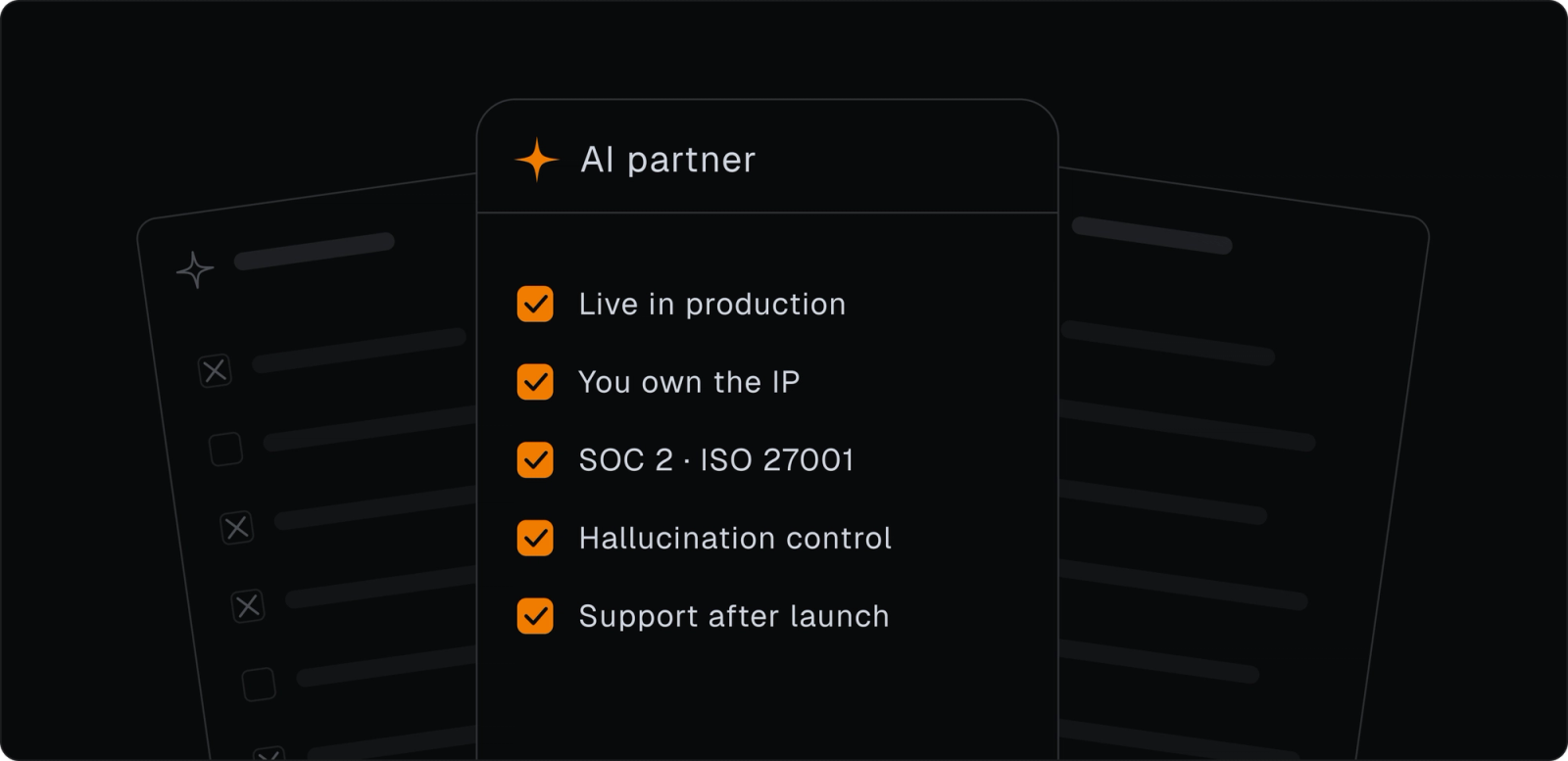
Once you have a shortlist, run every vendor through the same eight checks. Weight the first three the heaviest; they're the ones most correlated with a project that actually ships.
Ask for three current, live, production deployments. No case studies, no demos, no pilots that quietly wound down. For each, ask what the measured outcome was (accuracy, latency, cost saved, revenue lifted), and how long it's been running unsupervised in production. If your team has shipped just hackathon-grade prototypes, you might have a hard time answering this cleanly.
The quality of an AI system is only as good as the underlying data pipeline. A vendor that has built similar systems in your business already understands your data oddities, your compliance needs, and where the edge situations hide. Generalist teams can produce great work, but be prepared for a lengthier and more expensive discovery phase to get there.
MLOps maturity is one of the strongest indicators of whether an AI system can remain reliable after launch. Specifically ask about their model registry, versioning approach, drift detection, and retraining cadence. If a vendor can't explain how they'll notice and fix a model that has silently degraded in production, presume it will happen & no one will catch it.
Get this in writing before you get attached to a vendor. Review the data-use and intellectual property terms before you sign. Your contract should clearly state who owns your custom code, models, prompts, configurations, outputs, and project data, & if the vendor can use any of that stuff to improve its own systems or serve other clients. You want unequivocal, clear ownership of your own code, your fine-tuned models, your prompts, and your outputs, not a nebulous "we may use aggregated data" clause.
At a minimum, seek SOC 2 Type II & ISO 27001. If you're in a regulated industry, ask about HIPAA, GDPR, or CCPA as non-negotiables. Ask if the team has started to align to ISO 42001, the AI management-system standard that's quickly becoming the de facto enterprise buyer expectation in 2026. Obtain the actual present-day certificate, not just a claim on a website.
For everything LLM or generative model, just ask: "What's your process to detect and control hallucinations?" and "How do you test for bias before launch?" A vendor with a real solution will describe an evaluation process, human-review checkpoints, and audit trails. A seller without one will discuss "prompt engineering" and change the subject.
Vague, all-inclusive quotes are a red flag on both sides; strangely cheap typically indicates corners will be shaved on testing and MLOps; suspiciously expensive with no breakdown usually means you're paying for brand, not output. Ask for a breakdown by discovery, build, and continuing maintenance, and ask what happens to cost if scope changes mid-project.
An AI system requires ongoing care, monitoring, retraining, and incident response in ways that a typical web app does not. Confirm what support looks like after go-live, what the SLA is for a broken model in production, and just as important, what your exit clause looks like if the relationship doesn't work out. A vendor confident in their own work won't flinch at giving you a clean way out.
AI development costs vary substantially based on data complexity, integrations, model requirements, security requirements, and ongoing operations. The ranges below are illustrative benchmarks rather than fixed market rates.
| Engagement type | Typical cost | Best fit |
|---|---|---|
| Dedicated AI development partner | $40,000 – $400,000 to build, plus 15–25% of that annually for maintenance | Custom systems built on your own data, with ongoing evolution |
| Off-the-shelf AI/SaaS tool | $100 – $3,000 per month | Well-defined, common problems (support chatbots, basic analytics) that don't need custom modeling |
| Fully in-house AI team | $500,000 – $1,500,000+ per year, fully loaded | Companies where AI is the core product, not a supporting feature |
If a quote falls dramatically outside these ranges in either direction, ask why before you ask "where do I sign?"
Bring this list to every vendor call; the quality of the answers will tell you more than the quality of the deck:
Any one of these is worth a follow-up question. Two or more, and it's worth walking away.
The single best piece of risk-mitigation advice from 2026 buyers:
Skip the free demo & insist on a small, paid, time-boxed pilot instead, typically four to eight weeks, scoped to one real (if narrow) piece of your actual problem. A free demo shows you what a vendor can present. A paid pilot shows you how they work under a deadline, with your real data, communicating with your team, which is exactly what the next twelve months of the engagement will look like.
Three shifts have raised the stakes on vendor selection this year. First, the center of gravity has moved from "AI features" to AI agents that take real actions inside your systems, which raises the cost of getting integration and oversight wrong. Second, compliance expectations have hardened; ISO 42001 has gone from a nice-to-have to something enterprise buyers actively screen for. Third, scrutiny on data rights has increased industry-wide, as more buyers have learned the hard way that a vague contract clause can mean their proprietary data helps train someone else's model. This isn't to say that AI development has become more dangerous, but the distance between a trusted partner and rash decision-making has grown.
The AI landscape has altered radically.
Organizations are moving away from discrete AI features to systems that integrate with business data, applications, and workflows. AI agents are getting better at doing actions, not only generating responses, making integration, security, monitoring & oversight by humans even more critical.
At the same time, enterprise purchasers are paying more attention to AI governance, data rights, security, and operational accountability.
That means when selecting an AI development partner, you have to go beyond the technology itself.
The question you should never ask is:
"Can this company build AI? It is: "Can this company build an AI system that works reliably in our business, and support it after it goes live?
This is the benchmark for assessing an AI software development company in 2026.
Looking for a custom software development company that can show you real production deployments instead of a demo? Talk to techiebutler about your AI project; we build custom software and AI systems for teams that need something that still works six months from now.


